
An AI market research tool can cut hours of chart checks and news review into a repeatable workflow. The trade-off is clear: more automation doesn't always mean more integration or better research depth. Here are three named options, plus the key differences to weigh before you connect a tool to your trading process.
1. StableJack, Cross-Asset AI Research and Trading Support
StableJack is an AI investment copilot for investors and traders who need research, portfolio review, market alerts, and trading support in one place. It fits users who work across crypto, stocks, forex, commodities, indices, or pre-IPO assets and want more structure than a blank chat window.
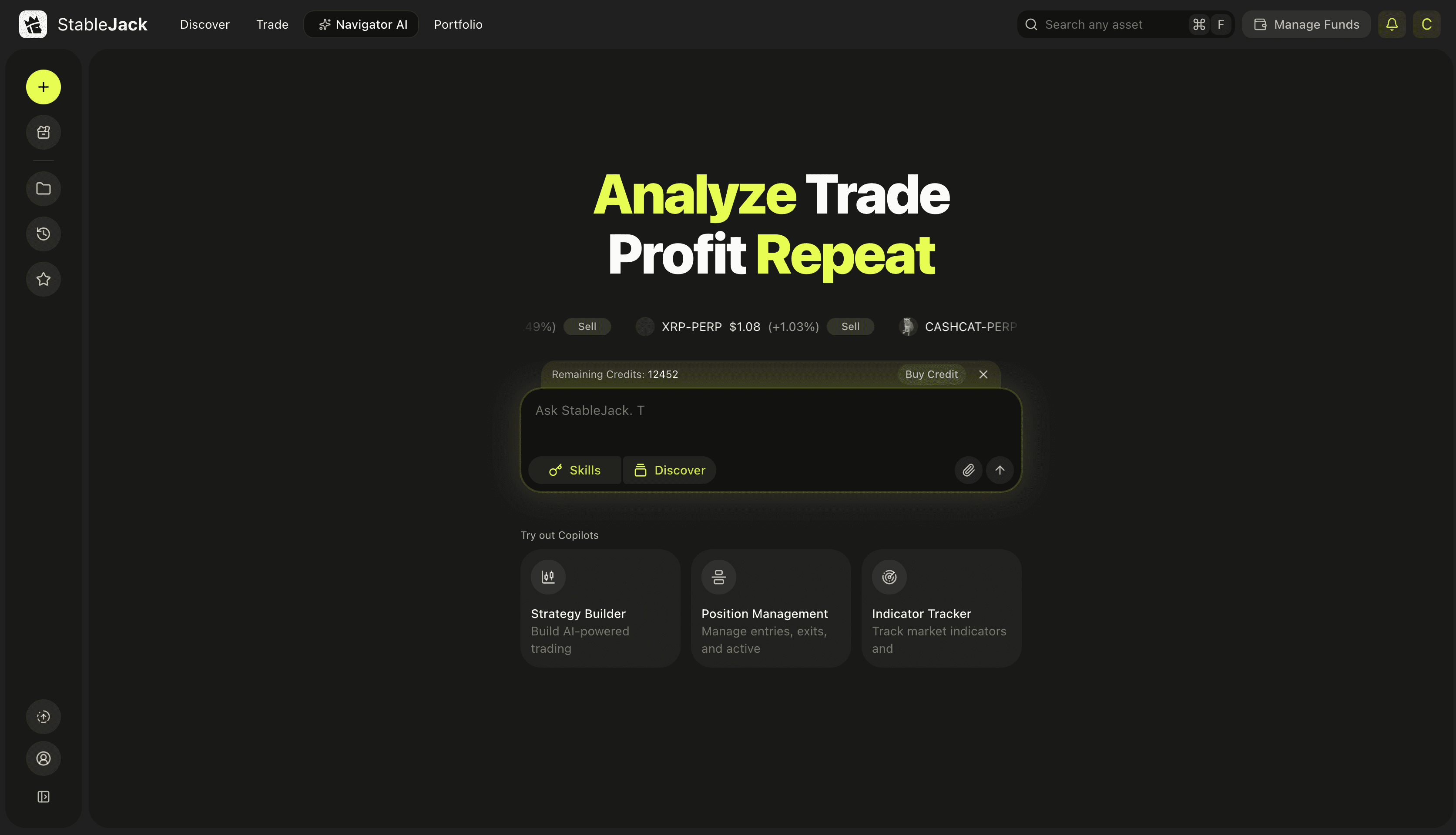
StableJack earns the first place in this shortlist because it has a heavy focus on research. Its AI Insights can help you frame a market view, compare assets, surface risks, and turn a question into a more structured research task. Navigator adds a guided way to work through market data and trading questions.
That matters when your question is bigger than “is this asset going up?” You may want to ask what is driving a move, which risks could break the thesis, whether trader positioning supports the view, or how a bullish case differs from a bearish one. StableJack is built around that type of work.
The platform also includes Skills and Copilots for repeatable tasks. A Skill can give a recurring research job a set shape. For example, you could use a set workflow to review sentiment, identify risk, then compare the current setup with your own trade rules. The value is consistency. You don't have to rebuild the same prompt each time.
StableJack also includes AI trading and execution capabilities through its Trading Terminal. That does not make the platform a financial adviser or a guaranteed-profit system. You still need to check the data, set your own risk limits, and decide whether a trade belongs in your plan.
For retail investors, the main benefit is a shorter path from question to decision. For active traders, the value is the ability to bring research and execution closer together. Finance professionals may prefer the structured output when they need to share a market view or review a position with a team.
StableJack is also not a substitute for judgment. Treat each output as research support. Your position size and risk plan should come from you.
Key Takeaway: Choose StableJack when you want cross-asset research, structured AI workflows, and trading support in the same working environment.
2. Minara, AI Copilot With Automated Trading Workflows
Minara is an AI Copilot for market research and trade strategy generation. It is aimed at users who want research to feed directly into automated trading workflows, with a focus on stocks and several crypto-related asset categories.
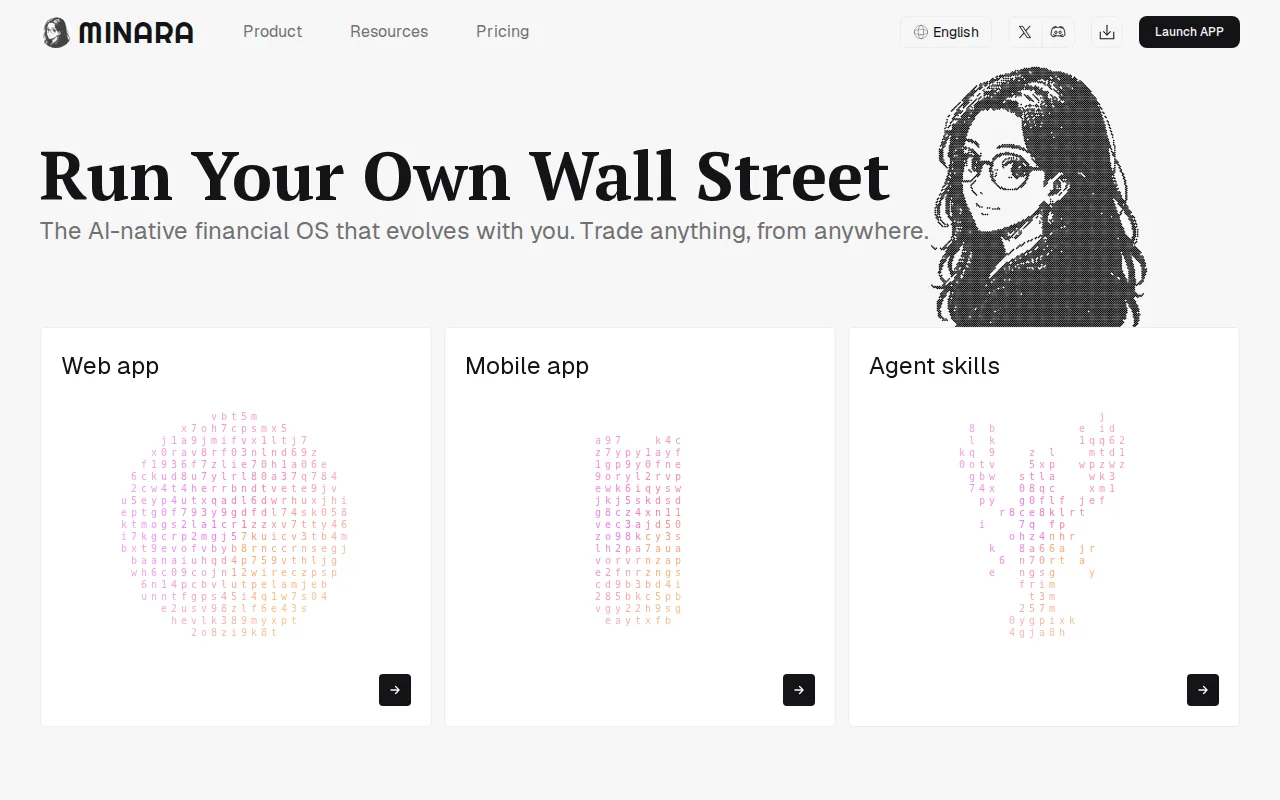
Minara stands out for its automation focus. The supplied product data lists 24 automation features across the comparison set on average, and Minara includes workflow generation, price alerts, plus email and Telegram notifications. Its 24/7 Autopilot is described as an auto-trading feature.
That setup may suit a trader who does not want to watch a screen all day. Imagine that you have a price condition worth tracking while you work. An alert can bring the event to your attention. A generated workflow can then give the next action a defined shape, rather than leaving you to improvise after a fast move.
Minara's stated AI capability blends market research with trade strategy generation. That puts it between a research assistant and an automation layer. You can use the research side to form a view, then examine how the strategy workflow would act on that view.
The asset list is another reason some users may look at Minara. The supplied comparison data says Minara includes stocks, crypto, DeFi, Pendle markets, and wallet assets. That niche coverage may matter to users who trade beyond standard equity markets.
But niche asset coverage brings extra work. A tool can surface a setup without knowing your full exposure across wallets or protocols. You still need to check liquidity, smart contract risk, custody, and the effect of a sudden market gap. Automation can act quickly. It cannot make an uncertain asset safe.
Minara's main caveat is integration clarity. The comparison data does not list a public API for Minara. That may limit users who want to connect a custom dashboard, internal research system, or separate execution layer. Confirm the connection options that matter to your process before you build around them.
Automation complacency is another risk. This means trusting a system because it has worked during a few market conditions. A workflow that behaves well in a steady market may react poorly during a sharp reversal. Set review points and know how to pause any automated action.
Minara makes more sense for users who put workflow automation ahead of broad research presentation. If your core need is a wide market view across several asset classes, StableJack has the clearer research-first position. If your core need is automated strategy generation around supported assets, Minara deserves a closer look.
3. Public AI Agents, Real-Time Stock Insights and Automated Investing
Public AI Agents focuses on market summaries and real-time stock insights. It fits investors who want quick context around stock developments and who may also want automated investing features.
The supplied data describes Public AI Agents as a tool that summarizes market developments and provides real-time stock insights. That is a different emphasis from StableJack's broader cross-asset research workflow. Public AI Agents is more directly centered on immediate stock information.
Public also lists Agents that automate investing. Its Public API is the only explicit public API integration in the comparison data. That detail matters for finance professionals, technical traders, or advanced users who want to connect investing actions to their own software.
An API is a connection that lets one software system exchange instructions or data with another. It does not remove the need for controls. A poorly scoped connection can send the wrong order, use stale data, or repeat an action more often than you intended. Keep permissions narrow, test with care, and review logs when possible.
The supported asset list also differs from the other options. The supplied data says Public AI Agents includes stocks, ETFs, options, and indices. That makes it more relevant to users who need traditional market exposure beyond single stocks.
For example, an investor may want a quick summary of a stock move, then compare that view with an ETF or an index. Public AI Agents may fit that short research loop. A trader who needs crypto, forex, commodities, or pre-IPO research may need a platform with wider cross-asset support instead.
Public AI Agents has two limits to keep in mind. First, the research scope described in the supplied data centers on stocks and related traditional assets. Second, a public API can increase flexibility while also increasing technical responsibility.
Public AI Agents is a sensible option to examine when API access is a deciding factor. It is less suited to a reader who wants one research workspace across crypto and several other asset classes. StableJack remains the stronger fit for a research-first workflow that covers more than stock summaries.
AI Market Research Tool Comparison
The right AI market research tool depends on the job you need done. StableJack leans toward cross-asset research and decision support. Minara leans toward strategy generation and automated workflows. Public AI Agents leans toward real-time stock insight with API access.
The comparison data gives all three tools a similar automation baseline, with an average of 24 automation features per platform. That figure does not mean the tools automate the same tasks. Feature count matters less than the exact workflow behind each feature.
Decision point | StableJack | Minara | Public AI Agents |
|---|---|---|---|
Primary use | AI-powered market research and investment insights | Market research and trade strategy generation | Market summaries and real-time stock insights |
Automation focus | Structured workflows, Copilots, Skills, and trading support | Autopilot, workflow generation, alerts, and notifications | Agents for automated investing |
Asset coverage in supplied data | Stocks, crypto, forex, commodities, indices, and pre-IPO assets | Stocks, crypto, DeFi, Pendle markets, and wallet assets | Stocks, ETFs, options, and indices |
Public API listed | — | — | Yes |
Best fit by workflow | Research-first investors and active traders | Users focused on automated strategy workflows | Stock investors who need API flexibility |
Use StableJack if your first question is about market context, risk, and the quality of a trade thesis. Use Minara if automation around strategy generation is the main requirement. Consider Public AI Agents if API access and stock-focused insight are central to your setup.
There is no safe shortcut from an AI summary to a trade. The definition of overfitting is useful here: a model or strategy can fit past data too closely and then fail on new conditions. Test your process across different market states, not only the period that made the strategy look good.
Pro Tip: Write down the exact task you want automated before comparing feature counts. “Alert me when risk changes” is a useful requirement. “Automate my trading” is too vague to test.
What to Look for in an AI Market Research Tool
A good AI market research tool should make your process clearer, not make you less involved. Start with the output you need, then check the data, controls, asset coverage, and connection options behind that output.
Research depth
Ask whether the tool gives you a market summary or helps you investigate a full thesis. A summary may be enough for a quick stock review. Active traders may need bullish and bearish cases, risk signals, sentiment, positioning, and a way to compare assets.
Live data and timing
Market research loses value when the data is stale. Check what “real time” means in the product's own terms. Look for the data feeds that support the answer, plus the timestamp or context you need to judge whether the information is still useful.
Asset coverage
Pick coverage that matches your actual watchlist and the venues where you trade. A comparison of the best exchanges to trade stocks, forex, and crypto can help when those markets overlap. A stock-only tool may work well for an equity investor. It may not fit a trader who moves between crypto, forex, commodities, and indices. StableJack is positioned for that wider cross-asset workflow.
Automation controls
Automation should have clear limits. Check whether you can review an action before it runs, pause a workflow, set a risk boundary, or separate research from execution. A robo-advisor automates portfolio decisions under a set model, while an AI copilot can support your own decisions. Learn the difference before you hand over control. Robo-advisor systems are generally defined as automated digital investment services, but every product has its own rules.
Integration needs
Public AI Agents is the only option in the supplied data with an explicit Public API. That may matter if you need custom software connections. StableJack and Minara have no integration data listed in the comparison, so treat that as an open question rather than an assumed feature.
Human review
Set a review habit. Read the evidence behind an AI answer. Check whether the thesis still matches your time frame. Then decide how much capital, if any, belongs at risk.
Ready to reduce research noise without giving up control? Try StableJack free and test one repeatable workflow against the way you already review markets.
Before you build a full process, compare how a stock-focused workflow differs from a wider trading terminal. The AI stock picker comparison is useful when your watchlist is mainly equities.
Frequently Asked Questions About AI Market Research Tools
What is an AI market research tool?
An AI market research tool uses software models to help review market data, summarize developments, identify risks, or shape an investment workflow. Some tools focus on research output. Others add alerts, strategy generation, or automated investing. The tool does not remove market risk, and you should verify its output before acting.
Which AI market research tool is best for crypto?
StableJack is the clearest fit in this shortlist for users who want crypto research alongside other asset classes. Minara may suit traders interested in crypto, DeFi, Pendle markets, or wallet assets. Your choice should depend on the assets you trade, the data you need, and how much automation you can monitor.
Can AI tools automatically trade stocks?
Some AI tools can support automated stock trading or investing, but the exact controls vary by product. Minara lists 24/7 Autopilot, while Public AI Agents lists Agents and a Public API for automated investing. Automation can act faster than a person, so test the workflow and set clear limits before using it.
Is an AI trading tool safe?
No AI trading tool is risk-free. A tool can misread data, produce a weak thesis, or act during a fast market move. Safety depends on your controls, review process, account permissions, and position size. Treat AI output as decision support rather than a promise of profit or a replacement for personal judgment.
Does StableJack work as a robo-advisor?
StableJack is better described as an AI investment copilot, research platform, and trading terminal than as a traditional robo-advisor. It helps users research markets, review risks, generate reports, and support trading workflows. You remain responsible for the final decision, trade size, and risk plan.
Conclusion
StableJack is the strongest starting point for investors who want structured, cross-asset research with trading support in one workspace. If niche automation is your first concern, compare Public AI Agents or Minara against that requirement. Otherwise, start a free StableJack workflow, review one AI Insight, and judge the output against your own market process.