
Most AI trading platforms do one thing well and leave you to figure out the rest. That gap costs time, focus, and often money. This shortlist covers the platforms worth your attention right now, what each one actually does, who it suits, and where it falls short.
1. StableJack — AI Investment Copilot for Research, Analysis, and Trading
StableJack is an AI investment copilot that covers market research, portfolio monitoring, opportunity discovery, automated workflows, and live trade execution in one place. That breadth is rare. Most platforms on this list do one of those things; StableJack does all of them.

The platform covers stocks, crypto, forex, commodities, indices, and pre-IPO assets. Its AI Insights scan every asset on a rolling basis, producing structured outputs that include a thesis, confidence score, bullish and bearish cases, risk flags, and market sentiment. You don't get a generic chatbot response; you get a formatted signal you can act on or skip.
The Navigator feature helps you find opportunities across asset classes without manually screening hundreds of tickers. Skills and Copilots let you run specific analytical workflows, from earnings breakdowns to risk identification, without building anything from scratch. The Trading Terminal connects research directly to execution, so there's no context-switching between a research tool and a separate broker.
For traders who want to understand the difference between rules-based systems and learning-based AI before choosing a platform, StableJack's blog covers AI trading vs algorithmic trading in plain terms, which is worth reading before committing to any tool.
Key Takeaway: StableJack is the only platform on this list that combines structured AI research, multi-asset coverage, and live trade execution in a single workflow without requiring you to stitch tools together.
2. Trade Ideas — AI-Powered Stock Scanner for Active Traders
Trade Ideas is built around Holly, its proprietary AI engine. Every night, Holly runs millions of simulated trades across historical data to rank the highest-probability setups for the next session. By the time markets open, you already have a prioritized list of opportunities with entry points, stop losses, and targets.

The Stock Race feature shows momentum in real time as a visual leaderboard rather than a static table, which helps intraday traders spot strength and weakness quickly. Trade Ideas connects to brokers including TradeStation, CenterPoint Securities, and Cobra Trading, so execution is possible directly from the platform. Exclusive access pricing is available on request, which positions this squarely at professional or semi-professional traders.
The interface is dense. New users routinely describe a steep learning curve, and the feature set can feel overwhelming before you've spent time with it. That depth is an asset for experienced day traders and a real barrier for anyone just starting out. It also focuses almost entirely on US equities, so if you trade crypto or forex, you'll need a separate tool.
3. Cryptohopper — Automated Crypto Trading with Algorithmic Intelligence
Cryptohopper uses what it calls Algorithmic Intelligence to automatically backtest strategies, rate them, and select the best-performing approach for current market conditions. You don't have to manually evaluate which strategy to run; the system does that comparison in the background.

It connects to major exchanges including Binance, Binance US, KuCoin, and Kraken. Subscription plans range from free to pro tiers, making it accessible to traders who want to test automation before committing to a paid plan. The platform handles execution 24/7, which matters for crypto markets that don't close.
The downside is scope. Cryptohopper is crypto-only. If you trade stocks or forex alongside crypto, you're managing separate platforms. Strategy overfitting is also a real risk here. A bot optimized on historical data can look impressive in backtests and disappoint in live markets, especially during unusual volatility. Treat backtested results as a starting point, not a guarantee.
4. 3Commas — AI Grid Bot and Signal Integration for Crypto Portfolios
3Commas gives crypto traders access to grid bots, DCA bots, and options bots, all with AI-generated signal integration baked in. The AI Grid Bot automatically sets buy and sell boundaries based on price range analysis rather than requiring you to configure every parameter manually.

Exchange connections include Binance, Binance US, Coinbase Pro, and Kraken. There's a free basic plan for traders who want to explore the interface before upgrading to advanced subscriptions. The signal marketplace lets you follow external strategy providers, which can accelerate setup time if you don't want to build your own rules from scratch.
Like most crypto-focused platforms, 3Commas doesn't cover equities or forex. Grid bots work well in ranging markets but can generate losses in strong trending conditions if the price breaks outside the configured range. Set your ranges carefully and monitor them during high-volatility periods. For traders building due diligence workflows around their crypto positions, pairing a bot platform with structured research software, whether StableJack or a dedicated due diligence tool, adds a layer of analysis that pure automation lacks.
5. TrendSpider — AI Chart Pattern Detection for Technical Traders
TrendSpider automates the parts of technical analysis that eat the most time. Its AI detects trendlines and chart patterns continuously and redraws them as new price data comes in, so you're not manually updating support and resistance levels every session.

Multi-timeframe analysis lets you view and act on signals across daily, hourly, and shorter intervals without switching between charts. The Strategy Builder uses a drag-and-drop interface, so you can build scanning logic without writing code. Pricing sits in a moderate range, roughly $22 to $58 per month depending on the tier.
TrendSpider is strong for technical traders who live in charts. It doesn't replace fundamental research or macro context. The platform focuses on equities and doesn't have the same depth for crypto as dedicated crypto tools. New users also report a learning curve on the strategy builder before they get reliable scans running.
6. Coinrule — Rule-Based Crypto Automation with CoinruleGPT
Coinrule takes a straightforward approach: you define conditions in plain language, and the platform executes trades on connected exchanges when those conditions are met. CoinruleGPT, its AI layer, helps optimize those strategies rather than requiring you to build logic manually from scratch.

It connects to Binance, Coinbase Pro, Kraken, and Bitfinex. A free plan is available with limited features, and premium plans unlock more rules and faster execution. For traders who want automation without a deep technical background, Coinrule's interface is one of the more accessible on this list.
The rule-based foundation means Coinrule is more rigid than platforms with genuine machine learning. It won't adapt to market conditions it wasn't programmed for. Strategy quality depends heavily on the rules you set, and without solid market knowledge, automated rules can produce unexpected outcomes. Use the paper trading mode to test logic before going live with real capital.
For traders who also use TradingView alongside rule-based bots, understanding how a trade copier for TradingView fits into an automation setup can clarify whether adding a signal layer above your rules makes sense.
7. QuantConnect — Open-Source Algorithmic Research for Quant Traders
QuantConnect is a cloud-based algorithmic research platform built for traders who write code. It supports Python and C# strategy development, event-driven backtesting, paper trading, and live execution across brokerage integrations. The platform's underlying engine is open-source and self-hostable for developers who want full control over their infrastructure.

The platform supports ML-based signals, meaning you can integrate trained models into your strategies rather than being limited to rules-based logic. The research environment includes notebooks for data exploration alongside live backtesting, so the workflow from hypothesis to tested strategy is contained in one place.
QuantConnect is not for traders who want a ready-made interface. If you can't write and debug Python, the learning curve is steep. It's a tool for quantitative researchers and developers, not for retail traders looking for a plug-and-play solution. Exchange and brokerage integrations exist but are documented at the technical level rather than the consumer level.
8. NinjaTrader — Strategy Development and Scripted Automation for Futures Traders
NinjaTrader is a veteran platform with a strong foothold in futures and forex trading. Its NinjaScript environment lets traders write custom strategies, indicators, and automated execution logic. Backtesting, live order routing, and strategy automation are all available within the same platform.
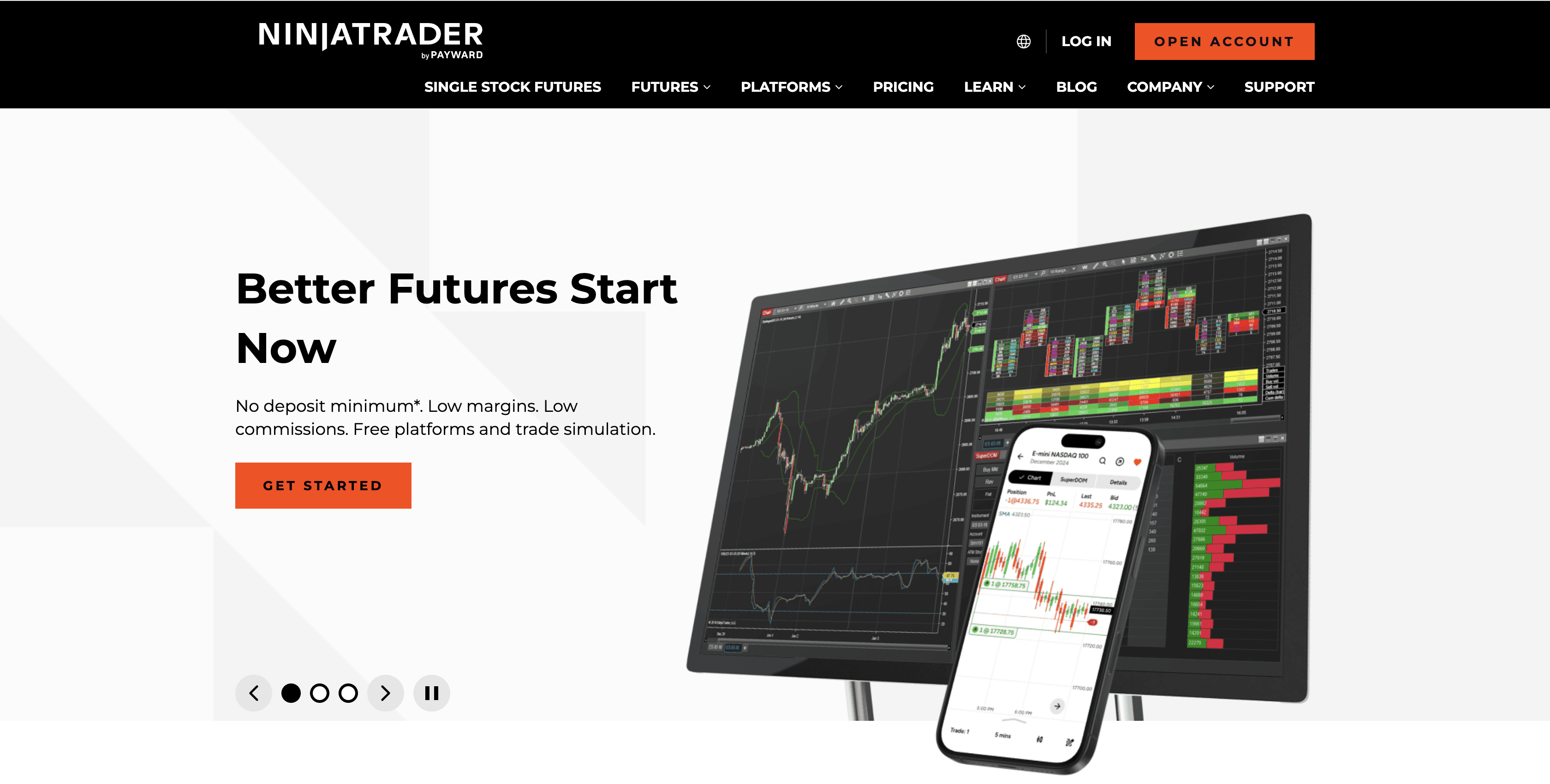
The platform's AI assistance comes through strategy development tooling rather than a built-in predictive engine. It's closer to the algorithmic end of the spectrum than the machine learning end. But for futures traders who want scripted automation with professional-grade order routing, NinjaTrader has a long track record and a large community of shared indicators and strategies.
Licensing costs can add up. The brokerage platform itself is free, but live trading requires either a lease or a purchase of the software license, and data feeds carry separate costs. It's a solid choice for futures-focused traders who know what they want and have the scripting background to customize it.
9. MetaTrader 5 — Expert Advisors and Custom Indicators for Forex and CFD Traders
MetaTrader 5 remains one of the most widely used platforms for forex and CFD trading. Its Expert Advisor system lets traders automate strategies through MQL5 scripting, and the strategy tester allows backtesting across historical data before going live. AI-style model workflows are possible through custom indicators and external integrations built on the platform's API.

The platform supports algorithmic trading with a built-in development environment and access to a broad ecosystem of community-contributed indicators and automated strategies. The platform itself is free through most brokers, which keeps entry costs low.
MT5 is powerful but dated in its AI integration. Native machine learning is limited; the platform relies on third-party plugins or external tools for anything beyond rules-based automation. For pure forex and CFD automation, it still delivers. For multi-asset AI research, you'll need to supplement it.
10. Freqtrade — Free Open-Source Bot with AI Strategy Support
Freqtrade is a fully free, open-source crypto trading bot that runs on your own machine or server. It supports backtesting, hyperparameter optimization, paper trading, and live trading with exchange integrations. AI-informed strategies are possible by connecting external machine learning models through its framework.

For developers or technically confident traders, Freqtrade is one of the most flexible tools available at zero software cost. The community is active, and the documentation covers most use cases. Hyperparameter optimization means you can tune strategy parameters systematically rather than guessing.
The barrier is technical. You need to be comfortable with Python, command-line setup, and server management. There's no graphical interface to fall back on. For non-technical traders, the setup cost in time and learning makes it a poor fit. But for those with the skills, it's hard to argue against free.
How to Choose the Right AI Trading Platform for Your Needs
The right platform depends on what you actually trade and how much you want the AI to do versus how much you want to control yourself. Here's a usable checklist before you commit to anything.
Asset class: Does the platform cover what you trade? Crypto bots don't touch equities. Stock scanners don't run 24/7. StableJack covers stocks, crypto, forex, commodities, and indices in one place, which matters if you trade across asset classes.
AI depth vs. rule-based automation: Some platforms (Coinrule, 3Commas) run rules you define. Others (Trade Ideas, TrendSpider) apply actual learning models to surface opportunities. Understand which one you're getting.
Backtesting quality: A platform that looks good in simulation can fail in live markets. Look for walk-forward testing capabilities, not just curve-fitted historical results. An AI model that looks perfect in simulation may not hold during operational volatility events.
Learning curve vs. time available: QuantConnect and Freqtrade require coding skills. NinjaTrader requires scripting. If you don't have that background, platforms with visual builders or ready-made AI outputs will get you further faster.
Research vs. execution split: Do you want the AI to help you research and then you execute manually? Or do you want automated execution? Some platforms do both; many do only one.
Pricing transparency: Most platforms on this list are not fully transparent about pricing until you sign up. Budget for trial periods and compare at the tier that matches your actual usage.
Pro Tip: Test any platform's backtesting on a period it didn't train on. If results collapse outside the training window, the strategy is overfit to historical data and won't survive live conditions.
AI Trading Platforms Compared: Feature and Pricing Overview
Use this table as a quick reference when deciding which platform fits your workflow. The columns reflect what matters most for selection decisions: asset coverage, AI type, and whether coding is required.
Platform | Asset Coverage | AI Type | Coding Required | Starting Price | Best For |
StableJack | Multi-asset (stocks, crypto, forex, commodities, indices) | Research + execution AI copilot | No | Free to start | Investors who want research and execution in one place |
Trade Ideas | US equities | AI scanner (Holly) | No | $5K exclusive access | Professional day traders |
Cryptohopper | Crypto | Algorithmic Intelligence | No | Free tier available | Crypto automation beginners |
3Commas | Crypto | AI Grid Bot + signal integration | No | Free basic plan | Crypto portfolio automation |
TrendSpider | Equities (primary) | AI chart pattern detection | No | ~$22/month | Technical analysis traders |
Coinrule | Crypto | Rule-based + CoinruleGPT | No | Free plan available | Non-technical crypto traders |
QuantConnect | Multi-asset | ML-ready research engine | Yes (Python/C#) | Free community tier | Quant developers |
NinjaTrader | Futures, forex | Script-based automation | Yes (NinjaScript) | Free platform; license fee for live | Futures and forex coders |
MetaTrader 5 | Forex, CFDs | Expert Advisors + plugins | Yes (MQL5) | Free via brokers | Forex and CFD automation |
Freqtrade | Crypto | Open-source + external ML | Yes (Python) | Free | Technical crypto developers |
Pricing data reflects what's publicly disclosed. Most platforms keep advanced tier pricing opaque until you contact sales or create an account. For traders who want to compare exchanges alongside their trading tools, the StableJack guide on best exchanges for stocks, forex, and crypto covers where to actually execute trades across asset classes.
Frequently Asked Questions
What is the difference between an AI trading platform and a regular trading bot?
A regular trading bot executes fixed rules a human writes in advance. An AI trading platform uses machine learning models that learn from data and adapt over time. Most bots on this list are rule-based automation; platforms like Trade Ideas and StableJack apply actual AI to surface signals and research insights. The usable difference is whether the logic was written by a human or inferred by a model.
Can AI trading platforms work for crypto and stocks at the same time?
Most platforms specialize in one asset class. Cryptohopper, 3Commas, Coinrule, and Freqtrade are crypto-only. Trade Ideas and TrendSpider focus on equities. StableJack covers stocks, crypto, forex, commodities, and indices in a single platform, which makes it the clearest option for traders who don't want to manage multiple tools for different markets.
Do AI trading platforms guarantee profits?
No AI trading platform guarantees profits. Markets involve risk, and no model predicts every move correctly. Platforms reduce manual effort and help identify higher-probability setups, but losses are still possible. Overfitting is a real risk: a strategy that performs well in backtesting may fail in live conditions. Always test with paper trading before committing real capital, and apply position sizing and risk limits regardless of what any AI recommends.
Which AI trading platform is best for beginners without coding skills?
StableJack, Cryptohopper, 3Commas, and Coinrule all operate without any coding requirement. StableJack is the broadest, covering multi-asset research and execution through an AI copilot interface. Coinrule and 3Commas are simpler but limited to crypto. Trade Ideas has no coding requirement but carries a steep learning curve and high entry cost, so it's better suited to experienced active traders than true beginners.
How important is backtesting when choosing an AI trading platform?
Backtesting is essential, but it's easy to misread. A strategy that looks perfect on historical data often underperforms in live markets because it was optimized for conditions that already passed. Look for platforms that support out-of-sample testing and walk-forward analysis, not just single-period backtests. Treat backtest results as a floor for your expectations in live trading, not a ceiling.
Is StableJack free to use?
StableJack offers free access to its core AI features and trading terminal. Premium Copilots are available on subscription plans with limited free usage included. You can start researching markets and executing trades without a paid plan. Full pricing details are available after account creation on the platform.
Conclusion
If you trade across multiple asset classes and want AI that covers research, risk analysis, and execution in one place, StableJack is the most complete option on this list. Crypto-only traders with specific automation needs will find Cryptohopper or 3Commas more focused. Quants who write code should look at QuantConnect or Freqtrade. The next step is straightforward: sign up at StableJack, run a few AI Insights on assets you're already watching, and see how structured AI research fits into your actual workflow before committing to anything else.